Project Overview
Over the coming years, Rijkswaterstaat is investing heavily in the maintenance, renovation and replacement of critical hydraulic infrastructure. Within the GRONST programme, several weirs receive more extensive maintenance than usual to ensure reliable operation until full renovation or replacement takes place.
A key challenge during the renovation of the Roermond Weir was the temporary dewatering of specific sections of the structure. Creating a dry working environment was essential for carrying out maintenance safely, efficiently and without the influence of flowing water.
Innovative Solution: Immersed Caissons
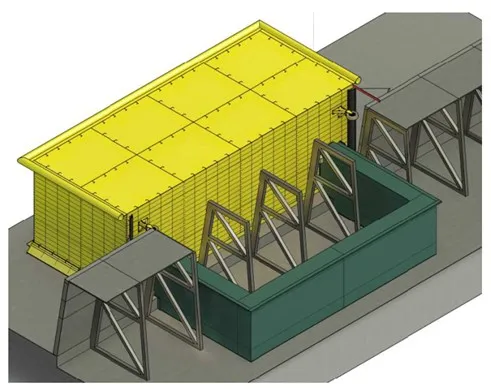
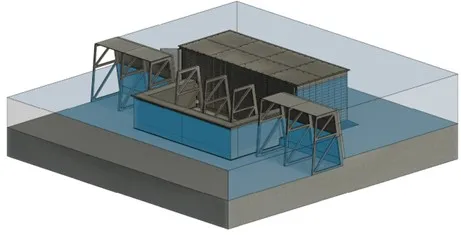
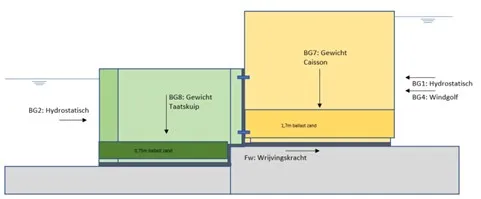
To address this challenge, MH Poly designed a unique solution consisting of two steel immersed caissons. These caissons create a watertight temporary construction cofferdam around sections of the weir, enabling maintenance activities to be performed safely in dry conditions.
The strength of this solution lies in its flexibility and reusability. The caissons are modular and assembled from individual elements that can be transported efficiently to the project site before being carefully immersed into position.
Once installed, the caissons provide a stable and watertight seal by eliminating buoyancy forces, allowing the structure to rest entirely on its own weight.
An important advantage of this concept is that no major modifications to the existing weir are required, such as drilling anchors into the concrete floor. This significantly reduces project risks, shortens construction time and minimises environmental impact.
Sustainable and Efficient Design
The immersed caissons were specifically designed for multiple reuse, allowing them to be deployed on various weir renovation projects throughout the Netherlands.
This makes the solution not only technically innovative, but also highly sustainable and cost-effective throughout its lifecycle.
MH Poly’s Scope of Work
Within this project, MH Poly was responsible for:
- Designing the immersed caisson structure
- Performing structural calculations and verification
- Developing the complete 3D structural model