
Project Overview
The flood defence surrounding Marken plays a vital role in protecting an area that lies largely below sea level (NAP). Due to climate change and rising water levels, sections of the western and southern dikes no longer meet current flood protection standards.
As part of the Marken Dike Reinforcement Project, carried out by Combinatie Hof op Marken on behalf of Rijkswaterstaat, the existing dike is being reinforced on the waterside by constructing a new, higher and wider dike against the existing structure.
A key objective of the project is sustainability through the maximum reuse of materials recovered from the existing dike, including rock revetments and foundation layers.
MH Poly's Role
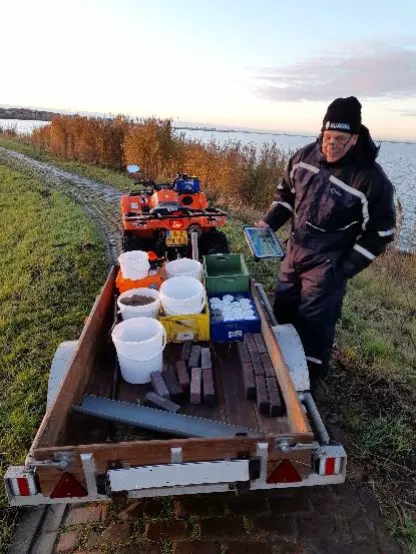
MH Poly was commissioned to assess the environmental quality and reusability of these materials. Between February 2022 and July 2023, a phased investigation was conducted into the condition of the dike revetment and the underlying construction materials.
The study specifically evaluated whether rock materials from the revetment, foundation layers and crest path could be reused in the new rock toe protection (toe berm)—a critical structural layer that absorbs wave energy and prevents erosion at the base of the dike.
To facilitate safe reuse, the materials were tested and certified in accordance with Protocol 1003 (batch testing of shaped construction materials).
Innovative GIS-Based Approach (ArcGIS)
The project made extensive use of ArcGIS, an advanced Geographic Information System (GIS), to digitally record, analyse and visualise all investigation data in real time.
This provided:
- Efficient collection and processing of field data
- Real-time insight for field teams, project management and the client
- Transparent collaboration and informed decision-making
- Accurate linking of investigation results to specific locations
Project Activities
Preparation Phase
- Analysis of soil and construction material data
- Assessment against the preliminary design
- Identification of material reuse opportunities
Execution Phase
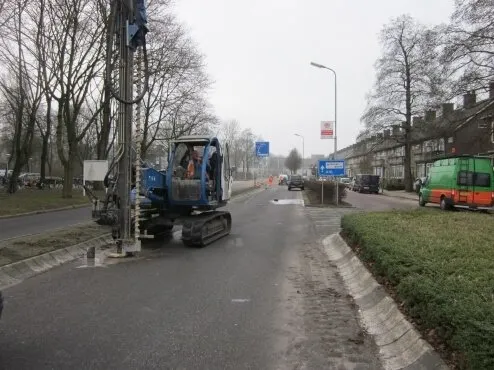
- Environmental supervision and on-site investigations
- Investigations in accordance with the following protocols:
- 1002 & 1003 – Rock and stone construction materials
- 2001, 2002, 2003 & 2018 – Soil quality and asbestos investigations
- Sampling and laboratory coordination by MH Poly’s in-house field team
- Close collaboration with the client and the contractor consortium
Results and Impact
The investigation provided detailed insight into the quality and suitability of the existing dike materials, allowing a substantial proportion of these materials to be sustainably reused in the new dike structure.
This resulted in:
- Reduced transport movements and lower CO₂ emissions
- Lower demand for new construction materials
- Circular reuse of valuable resources
- Improved long-term flood protection and climate resilience